 |
|||||
Simply grand
Rancho Santa Fe home is over the top, yet firmly rooted in nature
Roger M. Showley June 4, 2006
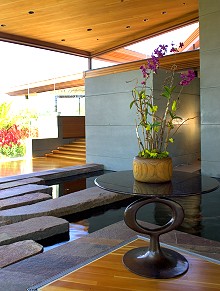
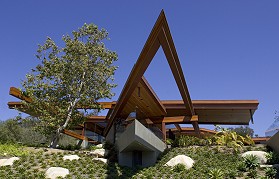
Charles H. Brandes' life is full of numbers, both finance and business, as he oversees $100 billion for clients at his 500-employee company, Brandes Investment Partners in Carmel Valley. “While the rest of the world rushes to buy great concepts or the latest high flyer,” he wrote in the third edition of his book, “Value Investing,” published in 2004, “the successful value investor must hang tough and stick to basics.” So, it's no surprise that when he bought 30 acres of prime Rancho Santa Fe land beginning in 1997, Brandes, 63, used the same patience-minded philosophy to build his dream home. Completed last fall, the 54,000-square-foot complex is expected to pencil out this month as the most expensive residence ever built locally, according county assessor Gregory Smith. Whether the final number totals $40 million, $60 million or more, the result of five years' construction shines through in a portfolio of smooth concrete, “floating ceilings” of glass and Douglas fir; a series of gardens worthy of Balboa Park; and world-class sculpture sprinkled about. Brandes and his wife, Tanya, who were married at the estate in April with Elton John providing the musical accompaniment, have hosted several charitable events since moving in last fall. Most recently, they welcomed about 235 guests to a $600-per-person dinner party for the Mingei International Museum, the size and type of group they planned the property to handle. However, the Brandeses cherish their privacy and only reluctantly agreed to open their home for a Union-Tribune reporter and photographer, though they declined to be photographed themselves. And yet they talked freely about the challenges of building a home that's warm and inviting – despite being nearly 10 times larger than the typical single-family home built today in San Diego County. Various missteps and snafus were as instructive as the solutions they reached in adapting an architect's vision to a family's practical needs. Sitting in the patio, paved with porphyry or volcanic stone tiles from Argentina and Italy, the couple contrasted their childhood architectural roots with what they built as adults. Tanya, who grew up in Los Angeles and graduated in chemistry from the University of Southern California in 1994, said her favorite domestic architectural style is 1920s Spanish Colonial revival – the traditional style in Rancho Santa Fe. Charles, who graduated in economics from Bucknell University in Lewisburg, Pa., in 1965 and did graduate work at San Diego State University, called himself a “brick guy,” because that's the traditional building style in his native Pittsburgh, where basements are standard and rose gardens freeze in winter. But neither stucco nor brick suited their vision for their California Xanadu, which they wanted to be simple, contemporary and in sympathy with the landscape. No crown moldings, elaborate wallpapers, thick-pile carpeting, gaudy furnishings and clutter here. “It's really based on our love of nature and the outdoors,” Charles said, explaining he wanted to incorporate some of Frank Lloyd Wright's indoor-outdoor design concepts. “We wanted an open house.” “Sun catchers” San Diego architect Norm Applebaum, the only architect considered for the Brandes commission, approached the challenge with his signature uses of cantilevers to stretch the bounds of geometric form. Long, 27-inch-thick steel beams, covered in wood, extend the roof as much as 85 feet beyond the walls, forming “sun catchers” that celebrate pure design and abstract concept. “When you start defying gravity, you create a mystique,” Applebaum said.“ (People will wonder) how did he do it?” The 125-foot swimming pool cantilevers out over a driveway and spills out into a waterfall and lake. The clay tennis court even cantilevers over one of the gardens. Inside, the walls start out as drywall or concrete and then become glass about 10 feet up, giving the impression that the roof is floating on air. The clear Douglas fir pattern on the floor repeats itself overhead. When the angle overhead changes, so does that of the floor below. The effect of all the glass, concrete and wood is akin to living in a woodcarver's handcrafted tool box. Hardwood was not chosen for a simple reason, Charles said: “It feels softer than hardwood. It gets marked up, but what can you do?”
Visitors will wisely cozy up to the 4-to 8-inch-thick coating of concrete over concrete blocks that form many of the exterior walls. It as smooth and flawless as plaster, its invisible vertical seams made possible by wrapping the concrete molds forms in neoprene – an idea suggested by surfers working on the project. Lang Contracting was the general contractor, and Sandpoint Construction handled the concrete work. The gabled clay roof tiles also are unique, an Applebaum-invented twist on the typical Spanish Colonial tiles covering so many Southern California homes. The Brandes decor is spare and minimalist. The furnishings and fixtures generally follow a neutral color palette of whites, tans and grays, leaving art objects, such as vases, sculptures and paintings, to provide splashes of color. There's one “wow” piece not to be missed – the red Yamaha baby grand piano autographed in gold paint by Elton John. The single-story home, raised about 30 feet from the ground, is bigger than it looks and posed a challenge to the architect. House within a house As Applebaum told Union-Tribune architecture critic Ann Jarmusch in a tour during construction and at an architects' forum where he discussed the project, “I pondered for months and months how to make it comfortable for human beings.” His solution was a “house within a house,” with areas zoned off in wings that seem to reduce the scale. Still, there are 10 bedrooms and even more bathrooms and enough indoor parking spaces for 45 vehicles. The living area measures about 26,400 square feet. Begun in 2000 after California Coastal Commission approval, construction involved dozens of workers at a time, after they demolished the previous house built by convicted savings-and-loan executive Don R. Dixon, regraded the property and installed new landscaping. County officials said they have rarely seen a home take so long to complete. Visitors arrive at the front door via a long driveway from the security gate, past some monumental sculptures (the Brandeses' favorite motif – animals – is reflected in bronze and stone statues of a horse, rabbit and cat) and ending at a parking lot at the foot of a monumental stairway lined with fountains and pools filled with koi. The story behind the front door is one of those chuckle-moments – how Applebaum suggested an 18-foot-tall, leaded-glass design but could find no suitable hardware to go with it. The compromise was a human-sized door, also of leaded glass manufactured by Antofte Stained Glass Studio in Pacific Beach, with the glass design extending to the roof. To the right of the entrance is a guest wing of six bedrooms, two of which have been converted to a game room and library. Each guest room has its own bath and door to a garden or private patio. “I don't think there's a room in the house that doesn't have a view,” Applebaum said. When it came to the living room and dining room, the open-space plan called for one giant space, the size of a hotel ballroom. Tanya said she grew up with a formal dining room and worked with Applebaum in creating a dining area without cutting up the larger space and destroying the open feeling. After toying with several computer-aided-design mock-ups, the solution was to locate the dining space against a short wall and facing the living room space and its nearly walk-in fireplace. The approximately 14-foot-long dining table is a thick piece of Bubinga wood, smoothly cut on one long side facing the wall, roughly hewn on the other facing the fireplace. The Brandeses found the piece in a New York City gallery. The setting is both noble and inspiring. But when a crowd gathers for Tanya's favorite Thai cuisine dinners, she said it doesn't matter that things can get noisy with all the hard surfaces in the large space. “What good is life if you don't have laughter and voices inside?” she said. Cup holders Through another wall of the living room not topped by glass is the screening room. Charles and Tanya can snuggle up alone or invite 10 other friends to take in a DVD of the week as they sink back into the soft leather lounge chairs, park their drinks in built-in cup holders and raise the foot rests at the push of an electronic button. Charles showed off the state-of-the-art Runco International projector system while Tanya fingered the acoustically correct wall covering hiding the multiple-speaker system. Sorry, no popcorn machine at the ready. The kitchen is Tanya's domain – Charles' is the outdoor barbecue – and she made sure, even in such a large house, that the distances were sensibly scaled to gourmet cooking. Around the corner is a catering kitchen, where the couple make the morning coffee and toast. (Charles said, out of frustration, he junked a high-tech toaster for a $35 model from a local drug store.) The master-bedroom suite continues the understated simplicity of the rest of the house. Yes, there are his and hers closets and sinks but no four-poster canopied bed. The view to the garden takes in a giant heart sculpture by pop artist Jim Dine. Family photos fill one wall at the entrance to the master bedroom, and Tanya has hung some of the the folk art she collected while living for about a year in South Africa. The couple currently shares a home office, decorated with some framed Dr. Seuss cartoons, but a second office is planned. Despite his occupation, there is no obvious sign in the office or anywhere else in the house that Brandes is a successful investment counselor. A tour of a big house is not complete without a visit to the most cherished space for many men – the garage. Accessed by stairs or an elevator, the underground space is big enough to accommodate 37 vehicles, according to the architectural plans. It is, like the rest of the house, lined in concrete and Doug fir, but unlike most other people's garages, there is an abundance of storage space and absence of the jumble most of us spend every fourth weekend cleaning up. The garage is so large because the Brandeses collect Ferraris. It's how they met, over a red Ferrari they each coveted. Leaving the residence, the Brandeses led a tour of the grounds on a golf cart. Michael A. Theilacker, retired from his landscape architecture firm KTU+A, oversaw the multiyear planning and planting of multiple zones. There's a palm grotto and Italian maze; rose garden (where Charles mixed the soil and Tanya planted the 37 bushes); a cactus desert drawn from an area cactus collector who sold his specimens before moving to Oregon; and fountains, pools, lawns and arbors. A citrus orchard and native plants area are on the property, and an herb and vegetable garden is in the works. And don't forget a children's playground; the barn for three quarter horses, Cee, Firefly and Dakota; a glass atrium for an iguana named Roxanne; and special spaces for the couple's turtles. (Tanya rescued one as it was crossing El Camino Real) The biggest snafu in the Brandes house story? An 89,000-pound boulder got stuck on the unpaved driveway, and extra trucks and a crane were brought in to lift it out and transport it to a waterfall. All because Charles and Tanya wanted authentic, not fake, rocks at their home on the ranch.
|
|||||
 Roger M. Showley: (619) 293-1286;